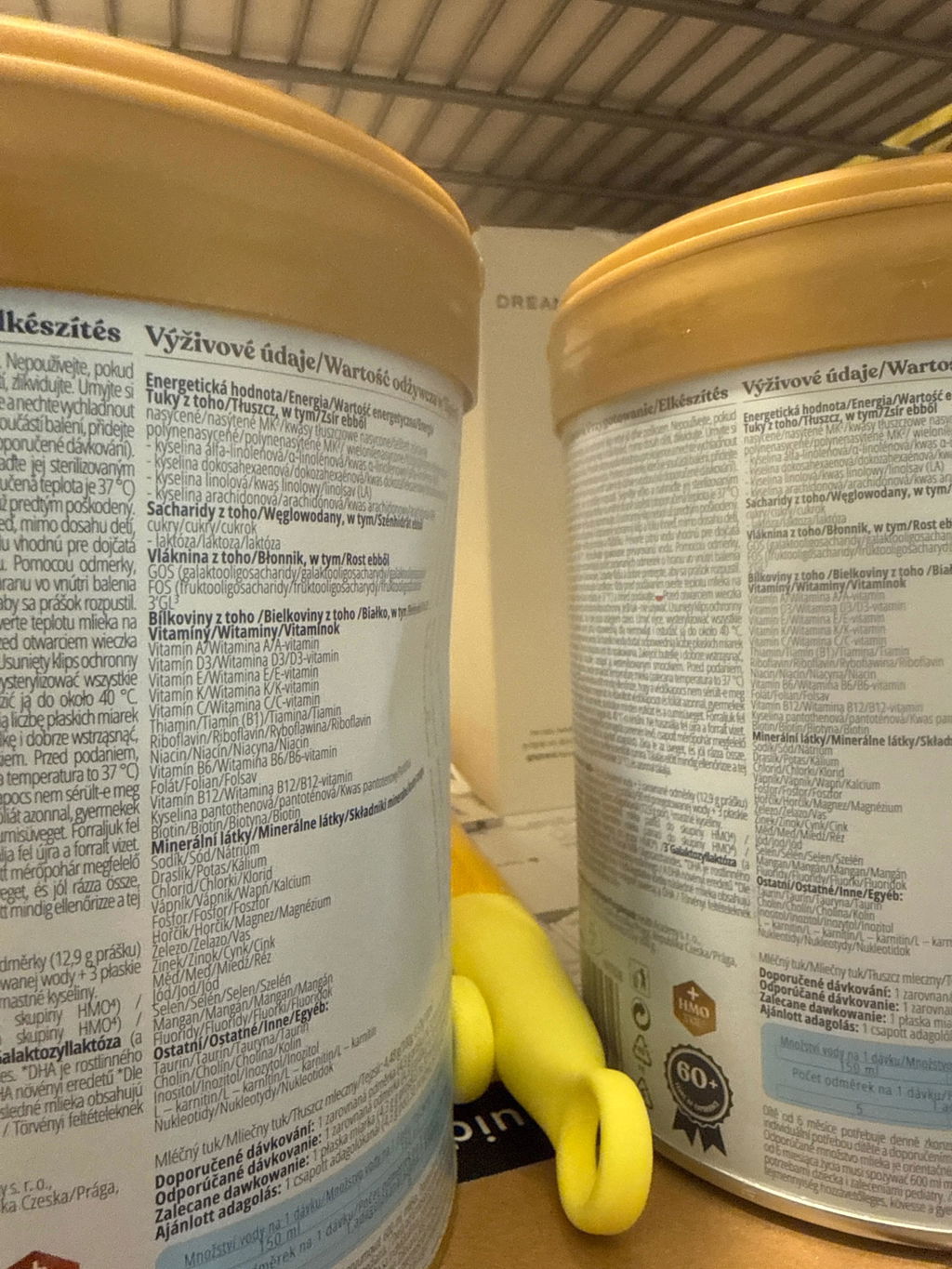

Short answer: You can move your baby from Similac to Kendamil by matching the Kendamil stage to your baby's age and then either switching straight over or blending the two for about a week to ease the taste and texture change. Kendamil is a UK-made, whole-milk formula with no palm oil, while Similac is a US-made formula built on nonfat milk and vegetable oils — so a short adjustment period is normal. Always prepare each tin by the directions on its own label, and check with your pediatrician before switching, especially if your baby was on a Similac specialty formula.
If you have been feeding Similac and keep hearing other parents talk about European whole-milk formula, you are not alone. Similac is one of the most widely used formulas in the United States, and Kendamil has become one of the most talked-about imported brands because of its whole-milk base and palm-oil-free recipe. Switching between them is usually straightforward, but a little planning makes it smoother for your baby's tummy — and for your budget.
This guide walks through how the two formulas actually differ, how to match the right Kendamil stage, a gentle step-by-step transition plan, how preparation changes, and what to expect in the first week. If you are weighing Kendamil against other European brands first, our pillar guide to the best European baby formula in 2026 is a good place to start.
What's in this guide
- Why parents consider switching from Similac to Kendamil
- Similac vs Kendamil: what's actually different
- Step 1: Match the right Kendamil stage
- Step 2: Choose Classic, Organic, or Goat
- Step 3: Make the switch (two gentle methods)
- Step 4: Learn Kendamil's preparation — it's different
- What to expect in the first week
- Who this switch suits (and who should ask first)
- Cost, single cans & subscribing
- Frequently asked questions
- Recommended Kendamil products
- Related articles
Why parents consider switching from Similac to Kendamil
Parents move from Similac to Kendamil for different reasons — and none of them mean Similac is a poor choice. Similac is a well-established, FDA-regulated US formula, and millions of babies thrive on it. Most parents who switch are simply looking for a particular recipe style: a formula built on whole milk rather than skimmed milk with added vegetable oils, a recipe without palm oil, or a brand that uses a vegetarian, plant-sourced DHA.
Kendamil is made in Cumbria, in the north of England, and uses whole milk as its main ingredient, which means some of the fat comes naturally from milk rather than entirely from a vegetable-oil blend. It is also palm-oil-free and uses DHA from marine algae instead of fish oil, which makes it vegetarian-friendly. These are recipe preferences, not medical upgrades — switching formula is not a treatment for any condition, and if your baby has reflux, allergies, or a diagnosed sensitivity, that is a conversation for your pediatrician first. For a balanced look at the two brands side by side, see our comparison of whether Kendamil is better than Similac.
Similac vs Kendamil: what's actually different
Before you switch, it helps to know what is changing in the can. Recipes are updated from time to time and vary by specific product, so treat this as a general picture and always read the current label on the tin you buy.
| Feature | Similac (e.g. 360 Total Care) | Kendamil |
|---|---|---|
| Made in | United States | United Kingdom |
| Milk base | Nonfat (skimmed) milk + vegetable oils | Whole milk as the first ingredient |
| Palm oil | Varies by product; check the label | No palm oil |
| Main carbohydrate | Lactose in 360 Total Care; some other Similac lines use corn syrup or corn maltodextrin | Lactose |
| DHA source | Algal oil | Marine algae (vegetarian) |
| Prebiotics / oligosaccharides | Added HMO prebiotics (e.g. five in 360 Total Care) | GOS/FOS prebiotics; a milk oligosaccharide (3'-GL) in some recipes |
| Regulation | Reviewed by the US FDA | Meets EU/UK standards; not reviewed by the FDA |
| Stages | Often one stage for 0–12 months | Stage 1 (from birth), Stage 2 (6–12m), Stage 3 (12m+) |
A quick note on that last row about regulation: European formulas like Kendamil are not reviewed by the FDA. They meet the European Union's own infant-formula standards, and US families typically buy them as personal imports through specialty retailers. It is neither "unsafe" nor "FDA-approved" — it is a different regulatory system. We explain this in plain language in our guide to European organic formulas vs. US brands.
Step 1: Match the right Kendamil stage
This is the most important step, because US and European formulas number their stages differently. Many Similac products are a single formula for the whole first year, while Kendamil splits the year into stages. Match by your baby's age and the age printed on the front of the box:
- Birth to about 6 months: Kendamil Stage 1 (First Infant Milk). In the UK this is a from-birth formula suitable right through the first year, so if your baby is still under 6 months, Stage 1 is where you start.
- Around 6 to 12 months: Kendamil Stage 2 (Follow-On Milk), once your baby has started solids.
- 12 months and older: Kendamil Stage 3 toddler milk.
Moving up a stage is optional rather than a deadline — a Stage 1 "from birth" formula provides complete nutrition through the first year, and the number on the tin is the brand's ladder, not an expiry date on the one below it. If you want to understand how stages work before you buy, see our complete guide on when to switch baby formula stages.
Step 2: Choose Classic, Organic, or Goat
Kendamil comes in a few lines, and Similac switchers usually land on one of the first two:
- Kendamil Classic (Premium): the whole-milk cow formula without the organic certification — typically the most budget-friendly way to try Kendamil.
- Kendamil Organic: the same whole-milk philosophy with EU organic certification.
- Kendamil Goat: a whole goat-milk recipe. Goat milk formula is a taste and style preference for many families; it is not a treatment for cow's-milk protein allergy, since goat milk proteins are similar to cow's. If allergy is a concern, talk to your pediatrician.
Not sure which fits? We break the three down in Kendamil Classic vs Organic vs Goat. Most Similac parents trying Kendamil for the first time start with Classic or Organic Stage-1 to match what their baby is used to.
Step 3: Make the switch (two gentle methods)
There are two common ways to switch, and neither is "more correct" — it depends on your baby and your pediatrician's advice.
Method A: The straight switch
Many healthy babies can move from one standard formula to another in a single day. If your pediatrician is comfortable with it, you simply finish your last Similac bottle and start the next feed with Kendamil, prepared to its own label. This is the simplest approach and works for plenty of families.
Method B: The gradual blend
If your baby has a sensitive tummy or is particular about taste, a slower blend over roughly 5 to 7 days can ease the change. A typical pattern looks like this — always prepare each formula separately to its own instructions first, then combine the prepared bottles:
- Days 1–2: about 75% Similac, 25% Kendamil
- Days 3–4: roughly half and half
- Days 5–6: about 25% Similac, 75% Kendamil
- Day 7 onward: 100% Kendamil
Go at your baby's pace — if a day feels rocky, stay at that ratio an extra day before moving on. The same gentle principles apply to any brand change; our general guidelines for transitioning to a new infant formula go deeper, and if you have been changing brands often, it is worth reading whether switching formula often is actually a problem (short version: usually not, but constant switching can mask what's really going on). If you have previously moved from Similac to a HiPP formula, the method is nearly identical — see our Similac to HiPP switching guide.
Step 4: Learn Kendamil's preparation — it's different
This trips up more switching parents than anything else. Do not reuse your Similac scoop or your old scoop-to-water ratio. Every formula has its own scoop size and its own water ratio, and mixing them up changes how concentrated the bottle is.
- Use only the scoop that comes sealed inside the Kendamil tin, and level it off — don't pack or heap it.
- Follow the water-to-scoop chart printed on the Kendamil label exactly. The amount of water per scoop may not match what you were doing with Similac.
- Add powder to water that has been boiled and cooled per the label's temperature guidance, not the other way around.
- When in doubt, the instructions on the tin always win over any chart you find online, including this one.
Our step-by-step walkthrough on how to prepare European baby formula covers Kendamil, HiPP, and Holle, including water temperature and storage of made-up bottles.
What to expect in the first week
A few changes are common when any baby moves to a new formula, and most settle within a week or so as your baby adjusts:
- Stool changes: color and consistency often shift with a new recipe. Whole-milk formulas can produce a different stool than a nonfat-milk-plus-oils recipe. A change in color alone is usually just the new formula.
- A bit more gas or fussiness for the first few days as the gut adapts.
- Taste reaction: whole-milk formula tastes creamier, and some babies take a feed or two to accept it.
Call your pediatrician — and don't wait out the week — if you see signs that aren't part of normal adjustment, such as a rash or hives, persistent vomiting, blood in the stool, breathing changes, or your baby refusing to feed and showing fewer wet diapers. This article is general information, not medical advice, and your pediatrician knows your baby's history.
Who this switch suits (and who should ask first)
A standard switch from Similac to Kendamil tends to suit parents who are feeding a healthy, full-term baby on a routine formula and simply prefer a whole-milk, palm-oil-free recipe. It is also a natural fit for families already leaning toward European formula for its ingredient style.
Check with your pediatrician before switching if your baby was on a specialty Similac — for example an extensively hydrolyzed, anti-reflux, or low-lactose product — because those were chosen for a specific reason, and a standard whole-milk formula is not an equivalent swap. The same goes for premature babies or any baby with a diagnosed feeding or digestive condition. Parents often consider a comfort-style formula in these situations, but that decision belongs with your pediatrician, not a blog.
Cost, single cans & subscribing
European formula is often compared on price by the tin, but the fairer comparison is cost per ounce of powder and cost per prepared bottle, since tin sizes differ between brands. Kendamil tins at EuromallUSA are 800g (and some 500g/600g options), and you can buy a single can rather than committing to a full case — handy when you are just trying the switch and don't yet know if your baby will take to it.
If the switch goes well and Kendamil becomes your everyday formula, the Subscribe & Save 10% option trims the ongoing cost and means you are less likely to run out mid-week. EuromallUSA ships Kendamil with fast, tracked U.S. shipping, and you can scale from one can to a multi-can pack once you know your baby's pace.
Frequently asked questions
Can I switch from Similac to Kendamil cold turkey?
Many healthy babies handle a direct switch between standard formulas just fine. If your baby has a sensitive stomach or is fussy about taste, the gradual blend over 5–7 days described above can make it smoother. Check with your pediatrician if you are unsure.
Is Kendamil FDA approved?
The FDA does not "approve" any infant formula — not Kendamil, not Similac, not any brand. US-made formulas are regulated and reviewed by the FDA, while Kendamil is made to EU/UK standards and is not part of the FDA's review system. US families generally buy it as a personal import through specialty retailers. For the full explanation, see our guide on whether European baby formula is legal in the USA.
Which Kendamil stage replaces my Similac?
Match by age, not by stage number. If your baby is under 6 months, start with Kendamil Stage 1; 6–12 months with solids, Stage 2; 12 months and up, Stage 3. The age is printed on the front of each box.
Will my baby's poop change?
Often, yes — a new recipe commonly changes stool color and texture, and a whole-milk formula can look different from a nonfat-milk-plus-oils one. A color change on its own is usually just the new formula. Blood in the stool, or hard stools with obvious discomfort, are worth a call to your pediatrician.
Do Kendamil and Similac mix safely in one bottle?
For a gradual transition you prepare each formula separately to its own label first, then combine the two already-made bottles. Don't mix the powders dry or guess at a combined scoop ratio.
Does Kendamil's recipe ever change?
Yes — like all brands, Kendamil updates its recipes over time, and ingredients can vary by market and stage. Always read the current label on your tin for the exact formulation rather than relying on an older chart.
Recommended Kendamil products
- Kendamil Classic (Premium) Stage 1 — whole-milk, palm-oil-free, from birth. The budget-friendly starting point for most Similac switchers.
- Kendamil Organic Stage 1 — the same whole-milk recipe with EU organic certification (0–6 months).
- Kendamil Organic Stage 2 — follow-on milk for babies 6–12 months who have started solids.
- Shop all Kendamil (Kendamil USA) — Classic, Organic, Goat, and toddler stages, available as single cans or multi-packs with Subscribe & Save 10%.
Related articles
- Is Kendamil Better Than Similac? A 2026 Parent Comparison
- Why Is Kendamil So Popular? Pros, Cons & Honest Review
- Kendamil Classic vs Organic vs Goat: Which Is Right for Your Baby?
- Where to Buy Kendamil Formula in the USA: A Safe Buying Guide
- HiPP vs Holle vs Kendamil vs Aptamil: Best European Formula in 2026
- How to Choose Baby Formula: A First-Time Parent Guide
The bottom line
Switching from Similac to Kendamil is usually a smooth change for a healthy baby: match the Kendamil stage to your baby's age, pick Classic or Organic to match what your baby is used to, switch straight over or blend gradually over a week, and learn Kendamil's own scoop and water ratio instead of reusing Similac's. Expect a few days of adjustment, keep your pediatrician in the loop — especially if your baby was on a specialty formula — and always verify the current label on your tin.
Ready to try it? Start with a single can of Kendamil Classic Stage 1 or browse all Kendamil options, and add Subscribe & Save 10% once you know it's the right fit for your family.
Sources
- Kendamil — Classic Stage 1 Product Data Card (official manufacturer ingredient listing)
- Similac (Abbott) — Similac 360 Total Care official product and ingredient page
- U.S. Food & Drug Administration — Infant Formula guidance and the personal-importation framework for imported formula
- American Academy of Pediatrics / HealthyChildren.org — general guidance on choosing and changing infant formula
This article is general information for parents and is not medical advice. It does not diagnose, treat, or prevent any condition. Formula recipes can change and vary by market and stage — always check the current label on your tin. Talk with your pediatrician before changing your baby's formula, especially if your baby uses a specialty or prescription formula.