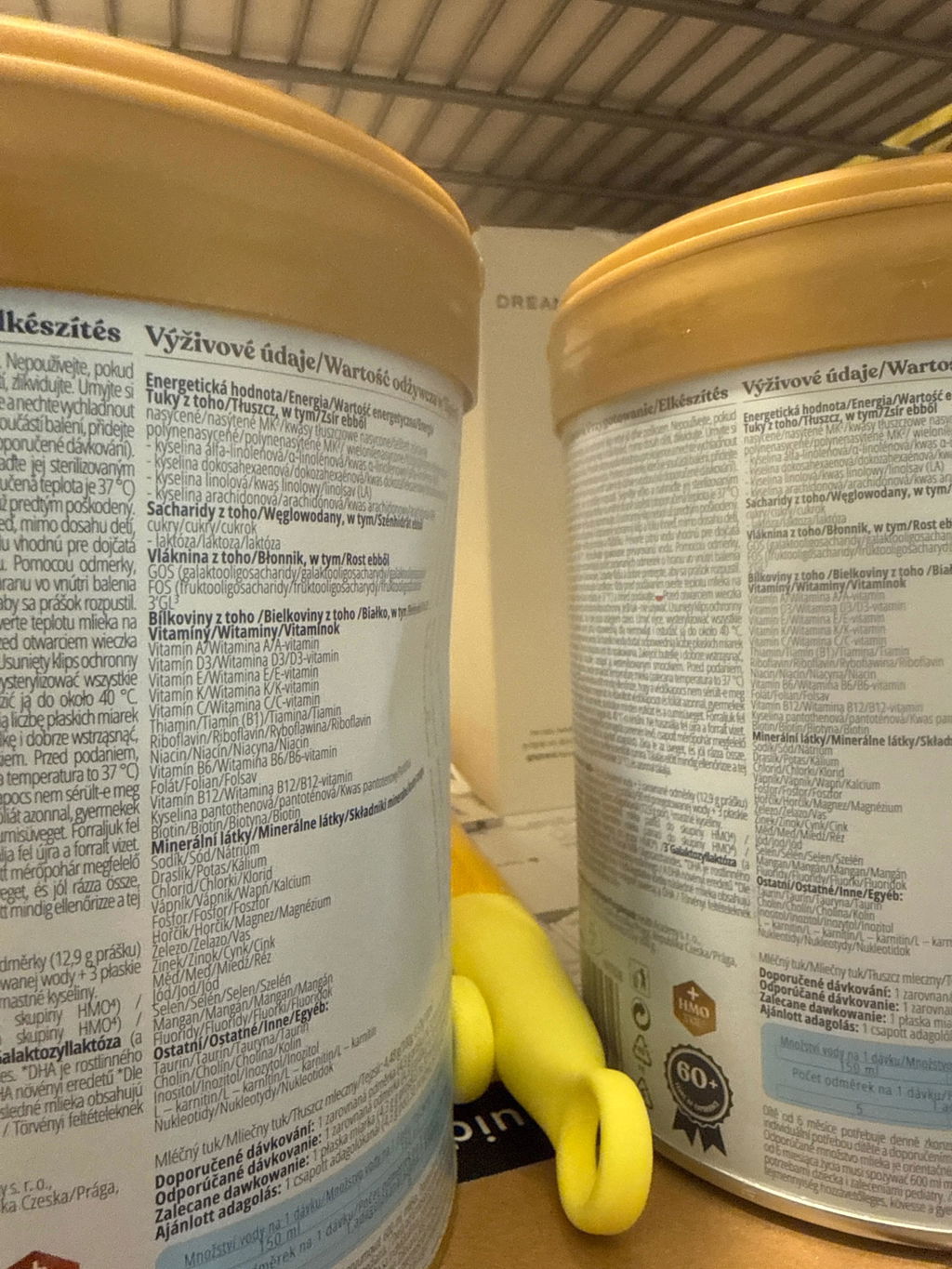


Short answer: Before changing from Enfamil to HiPP, discuss the exact products with your pediatrician, especially if your baby uses a specialty formula. Choose an age-appropriate product and prepare it using its own scoop and label instructions. The example schedule below is an optional gradual approach, not a medically required seven-day plan.
Many U.S. families start on a mainstream brand like Enfamil and later become curious about European organic formula. HiPP is one of the most popular European options because it is certified organic to EU standards, uses lactose as the main carbohydrate in its early stages, and includes its "Combiotik" blend of prebiotics and cultures. If you are thinking about making the change, this guide walks you through how to do it calmly and step by step — what to buy, how to taper, how to prepare each bottle, and what is normal to see afterward.
This article is for general information and is not medical advice. Formula recipes can change by market and over time, so always read your current package label and talk with your pediatrician before changing what your baby eats — especially if your baby was placed on a specific formula for a medical reason.
Table of Contents
- Why parents consider switching from Enfamil to HiPP
- Can you switch baby formula brands safely?
- Step 1: Match your baby's age to the right HiPP stage
- How Enfamil and HiPP compare (at a glance)
- Step 2: Switch gradually over about a week
- Step 3: Prepare HiPP with its own scoop and water ratio
- Step 4: What to expect in the first days
- Step 5: How much HiPP to buy for the switch
- Who this switch is — and isn't — for
- Frequently asked questions
- Recommended HiPP formulas
- Related articles
Why parents consider switching from Enfamil to HiPP
Enfamil is a well-known American brand regulated by the U.S. FDA, and many babies do beautifully on it. Parents who look toward HiPP are usually not saying anything is "wrong" with Enfamil — they are often drawn to a few specific things about European organic formula.
HiPP recipes differ by product, country and production version. German HiPP PRE uses lactose as its carbohydrate; German HiPP 1 BIO COMBIOTIK also contains starch. HiPP has announced revised German BIO COMBIOTIK recipes for autumn 2026, so check the actual package rather than relying on a brand-wide ingredient description. See the manufacturer’s recipe update.
European labeling or organic certification does not establish compliance with U.S. infant-formula requirements. Import requirements depend on the product and circumstances; do not assume that a personal-use order is automatically admissible. See U.S. Customs and Border Protection’s formula import guidance.
Can you switch baby formula brands safely?
For most healthy babies, switching formula brands is safe. Pediatric guidance in the U.S. (from groups like the American Academy of Pediatrics) notes that iron-fortified cow's-milk-based formulas are broadly similar in the nutrition they deliver, and that parents can change brands when they have a reason to. The appropriate method depends on the formulas and your baby’s needs. Ask your pediatrician if a gradual change is useful for your situation.
A few sensible cautions: if your baby is on a specialized Enfamil product for a diagnosed medical reason (for example a formula your pediatrician chose for a cow's-milk protein concern or significant reflux), don't swap it on your own — talk with your doctor first, because HiPP's standard organic lines are everyday infant formulas, not medical formulas. And remember that no formula, European or American, is specially formulated for cow's-milk protein allergy unless its label specifically says so. For the bigger picture on changing brands, see is it bad to switch baby formula often?
Step 1: Match your baby's age to the right HiPP stage
This is the step most parents miss. Enfamil typically uses a single infant formula for the whole first year (0–12 months), with specialty versions like Gentlease layered on top. HiPP instead uses a stage ladder, where the number is tied to age and feeding, not to a deadline. So you're not looking for "the HiPP version of Enfamil" — you're picking the HiPP stage that matches how old your baby is right now.
Here is how HiPP's German line maps to age (always confirm against the front of the box you buy, since the age band is printed there):
| Your baby's age | HiPP German option | Good to know |
|---|---|---|
| From birth | HiPP PRE or HiPP Stage 1 | Both are labeled from birth. German PRE uses lactose as its carbohydrate; German Stage 1 also contains starch. See HiPP PRE vs Stage 1. |
| 6 months + | HiPP Stage 2 | A follow-on formula for babies also starting solids. Moving up a stage is optional, not required. |
| 10 months + | HiPP Stage 3 | For older babies on a varied diet. |
| 12 months + | HiPP Kindermilch 1+ | A toddler milk — an option, not a requirement, after the first birthday. |
HiPP is sold in different market versions. Check the exact product’s age label, ingredients and preparation chart; similarly numbered German and Dutch products are not interchangeable descriptions.
How Enfamil and HiPP compare (at a glance)
Understanding the differences helps you know what to expect. This is a general comparison of typical standard versions — recipes vary by product and can change, so read the current label of whichever can you buy.
| Feature | Enfamil (U.S.) | HiPP (European) |
|---|---|---|
| Regulation | Made and regulated in the U.S. by the FDA | Made to EU standards; not FDA-reviewed; imported for personal use |
| Organic certification | Standard NeuroPro lines are not organic (Enfamil has limited organic options) | Certified organic to EU standards (German line carries Bioland) |
| Main carbohydrate | Lactose in standard NeuroPro Infant; Gentlease uses mostly corn syrup solids with reduced lactose | German PRE: lactose; German Stage 1: lactose plus starch. Later-stage recipes vary; check the current label. |
| Stage system | Usually one infant formula for 0–12 months | Age-based ladder: PRE / 1 / 2 / 3 / Kindermilch |
| Prebiotics & cultures | Includes prebiotics; some lines add MFGM and DHA | "Combiotik" blend: prebiotic GOS plus cultures, with DHA |
| Scoop & mixing | Follows the U.S. label (commonly 1 scoop per 2 fl oz) | Follows the EU label (HiPP German is commonly 1 scoop per 30 ml / ~1 oz water) |
If you want a deeper side-by-side of the two brands on their own, see our full Enfamil vs HiPP comparison. And if you're weighing European options more broadly, our pillar guide to the best European baby formula: HiPP vs Holle vs Kendamil vs Aptamil is a good next read.
Step 2: Switch gradually over about a week
If you and your pediatrician choose a gradual transition, change the feeding schedule rather than combining dry powders. In other words, prepare each bottle with only one formula, and slowly shift more of the day's bottles from Enfamil to HiPP. Do not mix Enfamil powder and HiPP powder in the same bottle — the two use different scoop-to-water ratios, and using one brand’s scoop or dilution ratio for the other can produce an incorrect concentration.
Here is an illustrative seven-day schedule if a gradual approach is appropriate. It is not a clinical protocol or a requirement for every baby:
| Days | Enfamil bottles | HiPP bottles |
|---|---|---|
| Days 1–2 | About 75% of bottles | About 25% of bottles |
| Days 3–4 | About 50% | About 50% |
| Days 5–6 | About 25% | About 75% |
| Day 7 onward | — | 100% HiPP |
Many parents like to keep the brand-new formula for daytime bottles at first, so it's easier to watch how baby responds while everyone is awake. If your baby seems extra gassy or unsettled on a given day, it's perfectly fine to hold at the current ratio for an extra day or two before moving on. There is no prize for finishing fast. This is the same gentle method we recommend for other brand changes, like switching from Similac to HiPP or switching from Similac to Kendamil.
Step 3: Prepare HiPP with its own scoop and water ratio
This is the single most important practical difference when you move from an American to a European formula. Always use the scoop that comes inside the HiPP can, and follow the preparation chart printed on that box. Do not reuse your Enfamil scoop or its "1 scoop per 2 ounces" habit — the scoops are different sizes and the ratios are different.
For HiPP German formulas, the common ratio is 1 level scoop per 30 ml (about 1 oz) of water, but you should always confirm the exact number on your current box, because it can differ by stage and market. A few preparation tips that carry over no matter the brand:
- Boil fresh water and let it cool to the temperature your box specifies before adding powder.
- Add water to the bottle first, then the powder — and level each scoop with the built-in leveler, never packed or heaped.
- Mix and test the temperature on your wrist before feeding.
- Use prepared bottles within the time your label states, and don't save a bottle your baby has already started.
Our full walkthrough on how to prepare European baby formula covers HiPP, Holle, and Kendamil step by step, and how to store baby formula safely explains how long powder, mixed bottles, and leftovers last.
Step 4: What to expect in the first days
When babies change formula, small changes are common and usually settle on their own as digestion adjusts. Knowing this ahead of time keeps you from worrying unnecessarily.
You may notice a change in stool color, texture, or frequency — this is one of the most common things parents see when the carbohydrate and protein blend changes, and it's normal within reason. Do not assume gas, fussiness or reduced feeding is simply an adjustment to prebiotics; discuss concerns with your pediatrician.
What is not part of a normal transition: persistent vomiting, hives or facial swelling, blood in the stool, signs of dehydration, or a baby who seems genuinely unwell. Those warrant a call to your pediatrician rather than waiting it out. For a calmer read on normal spit-up versus the kind worth asking about, see why babies spit up after feeding (and when it's normal). If your main reason for switching was fussiness or gas in the first place, our guide to what a comfort formula is and who it's for may help you decide whether a comfort option fits better than a standard switch.
Step 5: How much HiPP to buy for the switch
Because the first week is a trial, you don't need to stock up all at once. This is where buying by the single can is genuinely useful: you can pick up one can of the right HiPP stage, run the taper, and see how your baby does before committing to a larger supply. If it goes well, you can order more and review any available subscription terms on the product page.
To estimate how many cans you'll need per month once you've fully switched, our monthly formula calculator by can size does the math for you. Keeping one spare can on hand is smart, since you don't want to run empty halfway through a brand change. Check the selected pack’s availability and delivery estimate before ordering; dispatch and arrival times vary.
Who this switch is — and isn't — for
Parents often consider moving from Enfamil to HiPP when they want a certified-organic formula, prefer lactose as the main carbohydrate in the early months, or want to compare the ingredients in a European option. It can be a good fit for a healthy, growing baby whose parents like HiPP's ingredient approach and don't mind buying through a specialty importer.
It may not be the right move if your baby is thriving on a specialized Enfamil formula prescribed for a medical reason, if you need a formula that is specifically labeled for cow's-milk protein allergy, or if the convenience of buying on a local shelf matters most to you right now. When a medical need is involved, your pediatrician's guidance comes first. If you're still comparing European brands before you commit, the first-time parent's guide to choosing a formula and our look at European organic formulas vs U.S. brands are good places to think it through.
Frequently asked questions
Is HiPP FDA approved?
The FDA does not pre-approve infant formulas, but formulas marketed in the U.S. must meet applicable requirements. EU compliance is not a substitute for U.S. requirements. Check the FDA’s current information and CBP import guidance for the specific product.
Can I mix Enfamil and HiPP in the same bottle?
No. Prepare each bottle with only one formula. The two brands use different scoop sizes and water ratios, so do not combine dry powders or interchange scoops. To transition, shift whole bottles from one brand to the other over about a week.
How long does it take for a baby to adjust to HiPP?
There is no single adjustment deadline for every baby. Stool changes can occur after a formula change. If symptoms are unusual, persistent or concerning, contact your pediatrician.
Which HiPP stage replaces Enfamil Infant?
Match by age, not by the Enfamil name. For a newborn, that's HiPP PRE or Stage 1; from 6 months, Stage 2; from 10 months, Stage 3. Moving up a stage is optional — Stage 1 can be used for the whole first year if you prefer.
Do I have to move up a HiPP stage as my baby grows?
No. The stage numbers are an option, not a deadline. Many parents stay on Stage 1 through the first year. Our guide to switching formula stages explains when a change makes sense.
What's the difference between HiPP German and HiPP Dutch?
German and Dutch products can differ in ingredients, package size, age labeling and preparation instructions. Recipes also change over time; compare the ingredient lists on the exact packages rather than assuming an entire national range is palm-oil-free. See our German vs Dutch vs UK guide.
Recommended HiPP formulas
These are the HiPP German lines parents most often choose when switching. Buying a single can first lets you test the switch before stocking up; check current purchase and subscription options on the product page.
- HiPP PRE Combiotik — a from-birth newborn formula with lactose as the only carbohydrate.
- HiPP German Stage 1 — the popular from-birth option; can be used through the first year.
- HiPP German Stage 2 — a follow-on formula for babies 6 months and older.
- Browse the full HiPP Organic Formula collection or the HiPP German line to find your baby's stage.
Related articles
- Enfamil vs HiPP: Which Baby Formula Is Better for Your Baby?
- How to Switch From Similac to HiPP Formula
- How to Prepare European Baby Formula: Step-by-Step
- HiPP PRE vs Stage 1: What's the Real Difference?
- Where to Buy HiPP Formula in the USA
- HiPP vs Holle vs Kendamil vs Aptamil: Best European Formula (Pillar Guide)
The bottom line
Switching from Enfamil to HiPP is very doable for most healthy babies when you take it slowly. Match the HiPP stage to your baby's age, use a transition approach agreed with your pediatrician, shifting whole bottles if a gradual approach is chosen, prepare each bottle with HiPP's own scoop and ratio, and monitor your baby’s response. Start with a single can so you can see how your baby responds before you commit, and lean on your pediatrician for any question that's specific to your child.
Once you and your pediatrician have chosen an appropriate formula, browse the HiPP collection and check the exact product label, pack size, stock and delivery estimate. This article is general information, not medical advice.
Sources
- American Academy of Pediatrics / HealthyChildren.org — guidance on choosing and changing infant formula: healthychildren.org
- U.S. Food & Drug Administration — infant formula regulation overview: fda.gov
- HiPP — manufacturer product and preparation information: hipp.com (verify the preparation chart on your current box)
- Enfamil (Mead Johnson) — manufacturer product information for NeuroPro and Gentlease: enfamil.com